
Read Wabaunsee County Deed Types
The Wabaunsee County Register of Deeds records writings that affect real property. A deed names the parties, describes the land, and states the interest conveyed. Mortgages and liens often sit beside it in the records. They burden an interest rather than transfer it. The office also takes in assignments, releases, plats, surveys, oil and gas leases, powers of attorney, UCC filings, and tax liens. That list covers most of the filings a visitor will see.
| Deed Type | What It Does | Common Use |
|---|---|---|
| Warranty deed | Conveys title with stated covenants | Ordinary arms-length transfer |
| Quitclaim deed | Conveys whatever interest the grantor has | Family or title cleanup transfer |
| Special warranty deed | Limits covenants to the grantor's acts | Some business or estate transfers |
| Executor or trustee deed | Transfers through a fiduciary | Estate, trust, or court process |
| Tax deed | Reflects a completed tax-sale process | Delinquent-tax property |
A form label alone does not settle legal effect. Read the granting clause closely, along with the names, capacity, legal description, reservations, and recording reference. Mineral interests can be severed from surface ownership, and a lease or release can matter even when the owner of record never changed.
Wabaunsee Courthouse Index Access
The official Register of Deeds page states that recorded real-estate records are open to the public, though it publishes no online grantor-grantee search and no stated image cutoff. The counter at 215 Kansas Avenue in Alma is therefore the primary index. The county genealogy page points researchers to the alphabetical deed-index books when the legal description is unknown. For current access details, the official recorder page is the starting point.
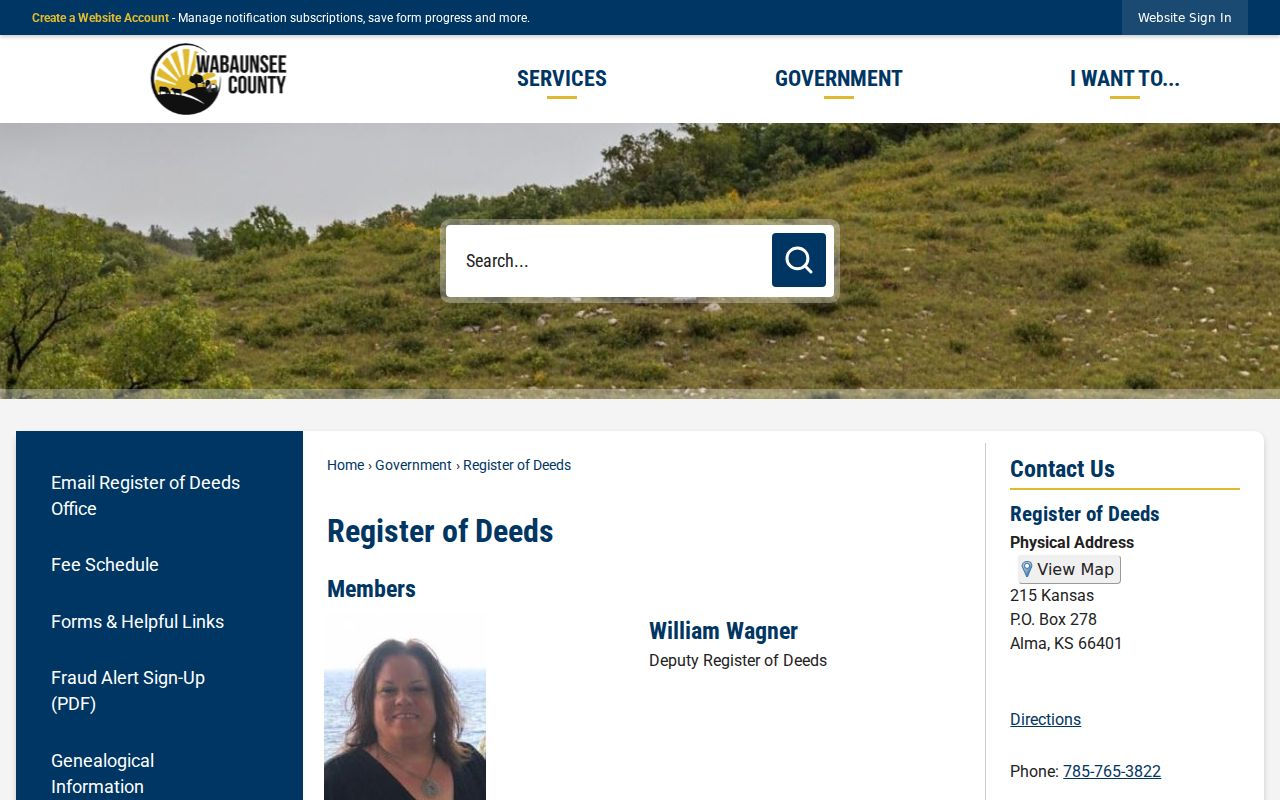
The deed chain still depends on the courthouse index. Bring both party names, an approximate date, and the current legal description. Those details help separate initials, married names, trustees, estates, and entities from one another. Phone the office at 785-765-3822 before a long trip whenever the request spans many volumes.
Follow Wabaunsee Grantor-Grantee Books
A grantor is the party transferring an interest. A grantee receives it. Either name in the alphabetical index points to the book and page or other recording reference for the instrument. The chain of title is simply the ordered series of those transfers for one parcel.
- Find the present owner's acquisition deed under that name as grantee.
- Read the grantor and exact legal description from the instrument.
- Search that grantor as an earlier grantee.
- Repeat while matching the same tract through every link.
- Grantor
- The party who transfers an interest.
- Grantee
- The party who receives an interest.
- Chain of title
- The linked sequence of recorded transfers for the land.
- Book and page
- A volume-and-page reference used to retrieve the writing.
Deed Records Begin in 1859
The Kansas Historical Society lists Wabaunsee County deed and property runs beginning in 1859. Its catalog covers deed indexes from 1859 to 1903 and 1870 to 1930, plus deeds, mortgages, and property records through 1949. Those are archival coverage dates, not an online county cutoff. The county microfilm program offers a research-room and loan route. A historic search should move from the current courthouse index into the right deed book or microfilm reel, without assuming every old image appears online.
Probate Can Bridge a Deed Gap
An inherited parcel may pass through an executor, administrator, trustee, survivorship clause, or court order. No routine sale deed is involved. Wabaunsee probate journals survive for 1859 to 1918 on five microfilm rolls, with a surname index. When the last grantor does not appear as the buyer in the prior deed, check the probate case. Also check any fiduciary instrument recorded afterward. Keep the legal description at the center of the search. Names can change over generations. Land descriptions provide continuity. A probate order explains the authority, while the deed record shows the resulting conveyance.
Wabaunsee Recording Fees and Timing
The county fee schedule lists $21 for the first page of a recorded real-estate writing. Each added page costs $17. Plain copies run 50 cents per page, and certification adds $13 to the copy charges. Instrument-specific charges can differ. Confirm the current schedule for plats, releases, liens, or UCC records. The office cuts off recording at 3:45 p.m. A document arriving later records the next morning. That timing matters when comparing a new deed with an older tax-roll owner. The recording date and the appraisal database update are separate events.
Free Wabaunsee Recording Alerts
Wabaunsee County offers a free recording-notification signup. It can send an early email alert when a subscribed name appears in a new recording. The program drew attention in 2026 fraud-prevention testimony and helps spot an unexpected filing quickly. An alert does not block an instrument. It does not search the historical chain or insure title. Name variations can affect matching too. Review any notice against the official index. Contact the recorder through a known county number rather than contact information supplied in an unsolicited message.
Inspect a Wabaunsee Recorded Instrument
Once the index points you to a deed, check it against the parcel itself. Party names alone will not settle anything. Read the execution date and the recording date as two separate facts. Write each grantor and grantee exactly as the instrument spells them. Note any trustee, executor, marital, or company capacity. Record the book and page or other reference number. Then copy enough of the legal description. Match it against the tax account and the recorded plat in Wabaunsee County.
Deed types matter. A warranty deed and a quitclaim deed both transfer an interest, yet their promises differ sharply. A quitclaim passes only what the grantor actually holds, with no guarantee the interest is complete. A fiduciary deed signals that an executor, administrator, or trustee acted under legal authority. Tax deeds and sheriff's deeds follow their own statutory or court process. Read the recitals and any cited case numbers when the transfer is not a routine sale in Wabaunsee County.
Encumbrances deserve separate attention. A mortgage, lien, assignment, lease, or easement does not by itself change the owner of record. Look for a matching release, satisfaction, or later assignment, and confirm the legal description agrees. The county also records oil, gas, and severed-mineral writings, which can form a chain apart from surface title. Never assume one release covers another lien just because the names resemble each other.
Plats and surveys clarify lot-and-block deeds. A current legal notice may cite an Alma, Maple Hill, or Eskridge addition name. That name also turns up in old deed records. When a tract was replatted, follow the recorded plat reference that changed its description. ORKA helps locate the land, but the screen polygon cannot rewrite the deed or the plat.
A gap in the chain calls for probate and district-court records in Wabaunsee County. An estate proceeding, quiet-title order, partition, or foreclosure often explains the shift. It shows why the next instrument names a different party or capacity. Kansas CaseSearch indexes public case information, though the local terminal or clerk may hold the actual document. Afterward, return to the recorder to see how the judgment or fiduciary transfer entered the land record.
Keep a log of every instrument you copy. Track the date, deed type, grantor, grantee, description, reference, and source. That discipline keeps a proven deed link distinct from an unconfirmed clue. The clue may sit in a tax roll, atlas, notice, or case result.
Order a Wabaunsee Deed Copy
You can request a Wabaunsee County deed copy at the recorder counter. You can also order one by contacting the office. Give staff the party names and an approximate recording date. Include the legal description and the book/page or instrument reference. Say up front whether a plain image suffices or a certified copy is required. Mail and KORA requests should describe an existing record in enough detail for staff to locate it. Allow for search, copy, postage, and certification costs.
For a broad historic project, find the index entry first. That simple step keeps staff time and cost down. For a current transaction, ask whether a later instrument was recorded. It may sit under a trust, estate, or entity name.
Recorded, not guaranteed. Wabaunsee County deed records show filed instruments. They do not resolve every defect, unrecorded claim, boundary issue, or legal priority.