
Read Wabaunsee Property Tax Records
Wabaunsee County property tax records are split between appraisal and collection. The Appraiser inventories land and improvements and sets fair market value as of January 1. Kansas class rules turn that figure into assessed value. The Treasurer bills, collects, and distributes the tax. The CIC search provides current and previous statements and a due-only filter.
| Field | What It Shows | Where |
|---|---|---|
| Market value | January 1 estimate | Appraiser roll |
| Assessed value | Classified taxable share | Appraiser roll |
| Tax type and year | Holding category and statement period | CIC tax search |
| Bill status | Paid, due, or delinquent | Treasurer record |
| Taxing units | Jurisdictions forming the levy | Tax statement |
Market value, assessed value, and sale price are three different numbers. The bill applies district levies to assessed value. A deed may state consideration. But no figure here replaces a private appraisal of what a property might sell for today.
Search Wabaunsee Tax Fields
The official CIC Tax Information Search reaches real estate. It also covers personal property, oil and gas, mineral, truck, utility, and other account types. Searching by name or street often returns a list of candidates. A CAMA or Tax ID search is far more exact.
The county's value explanation page outlines the Appraiser's January 1 appraisal role.
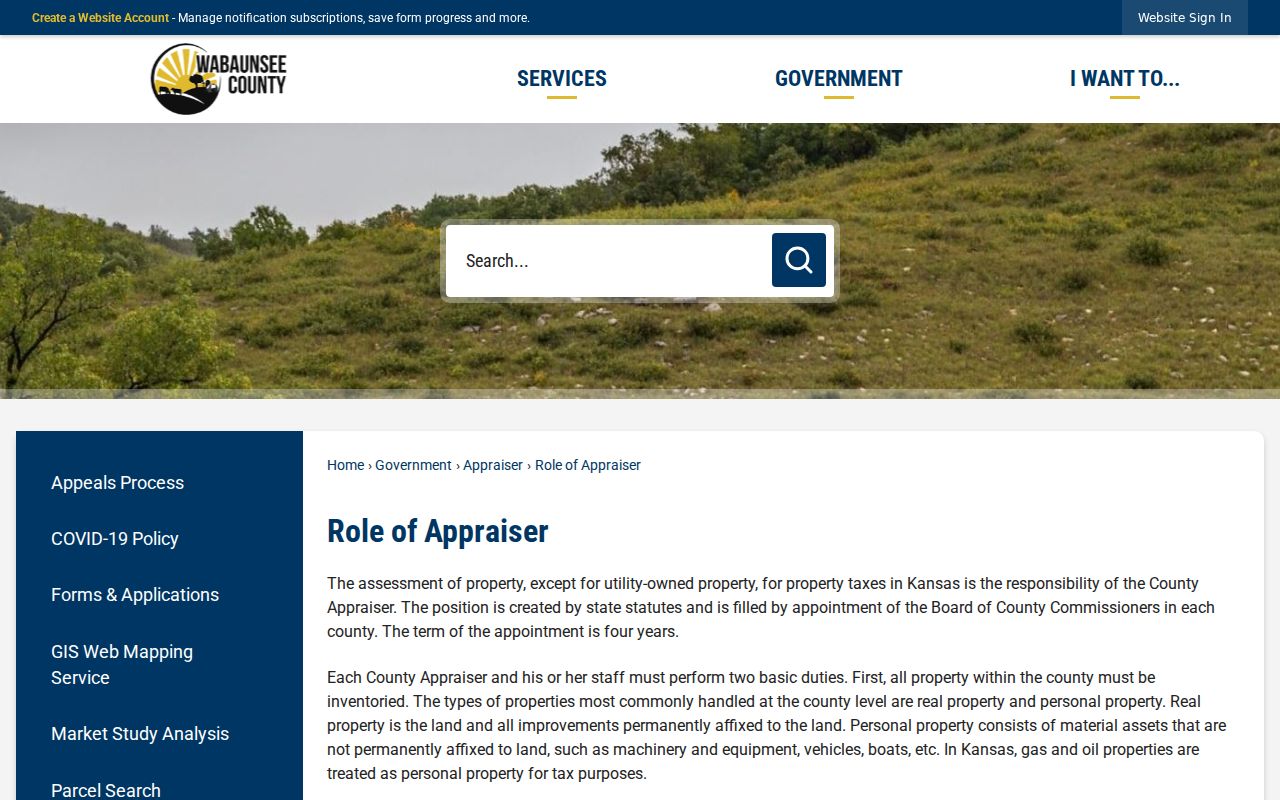
The captured page separates the Appraiser's valuation work from the Treasurer's billing role.
| Field | Entry | Best use |
|---|---|---|
| Taxpayer | Person or entity | Current roll matches |
| Address | Number and street | Known site |
| CAMA | Eight-part key | One appraisal account |
| Subdivision | Plat or addition | Town lots |
| Section, township, range | Rural description | Land without a street address |
Portal update dates describe only the database. They are not deed dates, so treat them as no proof of a recent transfer.
Find a Wabaunsee Tax Bill
Start with real estate, pick the statement year, and search. A broad owner or address query may return several parcels. Match the full CAMA number, situs address, and legal description before opening a bill. Then check the installments and status for that specific year.
- Search CIC by address, taxpayer, or CAMA.
- Confirm the parcel and choose the tax year.
- Compare Appraiser value and classification.
- Verify paid, due, or delinquent status with the Treasurer.
- Assessed value
- The classified share used in the calculation.
- Mill levy
- A rate per thousand dollars of assessed value.
- Homestead refund
- A Kansas refund with separate eligibility rules.
- Tax lien
- A legal claim from unpaid tax.
Kansas Ratios Shape Wabaunsee Tax
Kansas appraisal ratios shape every Wabaunsee tax bill. Residential real property is assessed at 11.5 percent of value, while commercial and industrial property is assessed at 25 percent. Agricultural land gets valued by use and assessed at 30 percent, and farm homes and improvements fall under their applicable classes.
The ratio is not the tax rate. It only produces assessed value. Taxing-unit levies then build the actual bill. Because of class, use, exemptions, and district differences, two parcels with similar market values can owe very different taxes.
Wabaunsee Exemptions and Refunds
Kansas publishes state exemption procedures and a separate K-40H homestead refund route. A refund is not the same as an exemption shown on the parcel. Check the Appraiser's classification, then follow the current state form for the program in question.
Never infer eligibility from an owner's age, address, or name. Each form demands its own proof. County staff can explain the local record. The Kansas Department of Revenue controls the state program instructions.
Wabaunsee Delinquent Tax Notices
Delinquent tax notices are published locally. They may list owners, additions, lots, blocks, and rural descriptions. One 2025 notice covered named land in Alma, Maple Hill, and Eskridge. Such a notice is a dated status source. It is not proof the sum is still due or that a tax deed has issued.
Always confirm the account with the Treasurer. Later court, sale, or deed records may change the result.
2026 Wabaunsee Value Trends
The county's 2026 Market Study points to residential movement near 2.7 percent per year. Agricultural values are rising about 4.1 percent for 2026. Commercial and vacant-lot categories were described as stable. These are countywide findings, not automatic parcel changes.
Land use, class, improvements, location, and sales evidence still control each individual record. Read your parcel notice rather than applying a countywide percentage.
Reconcile a Wabaunsee Tax Account
Start any Wabaunsee County property tax records search with two anchors. Pick one account type and one year. The CIC system covers real estate, personal property, oil and gas, mineral, truck, utility, and other accounts. A single owner name can surface under several of them. Choose real estate for a land parcel. Then verify the full CAMA account and legal description before trusting the statement on screen.
Current and past statements answer separate questions. The current statement covers the active billing period. A prior-year view gives a dated account history you can cite. The due-only option helps when hunting an unpaid balance. Yet a clean past notice settles nothing about title and never erases the historical publication. For a payoff figure or certified status, call the Treasurer directly.
Dates matter here too. January 1 fixes the valuation. The appraisal portal and tax page can both display later update timestamps. Those database stamps are not sale or recording dates. The tax bill follows the certified value once levies are set. So a freshly recorded deed may put a new grantee on title. The tax account name may catch up later.
A surprising assessed value often traces to classification. Kansas applies different ratios and valuation methods to residential, commercial, agricultural, and other classes. Agricultural land runs on use value rather than a market-sale figure. Keep exemptions and refunds distinct as well. Exempt status can change the taxable record. The homestead program, meanwhile, issues a state refund under its own eligibility rules.
Appealing? Save the valuation notice and move inside its 30-day contact window. Build parcel-specific proof. A correct legal description, building measurements, condition photos, and sales evidence tied to the valuation date all help. A countywide market-study percentage adds context but proves nothing about one parcel. Remember that equalization contests appraisal only; it cannot rewrite school, city, county, or special-district levies.
Older statements and appraisal rolls may simply not exist online. Ask the Treasurer or Appraiser in person, by phone, or in writing. A KORA request should name the parcel, the year, and the exact record sought. Staff time, copies, postage, and other actual costs may apply under county procedure.
Always read a tax record alongside its source date. When documenting payment, an appeal, estate work, or a purchase review, save the statement you relied on. A later online view may already reflect a payment or a correction. The earlier search never showed that change. The printed or saved copy preserves what the record actually said that day.
Contest a Wabaunsee Assessment
A valuation notice starts a clock. The owner has the notice's 30-day contact period to open the equalization route with the county Appraiser. Kansas also offers a payment-under-protest route that begins after billing, with its own timing and forms. Strong evidence includes the correct description, photos, measurements, condition facts, comparable sales, and proof of a class error. An appeal addresses value alone. It does not change a taxing district's levy.
Watch the notice date. The local 30-day equalization period runs from the valuation notice, not from the day a tax bill is viewed.