
Trace Wabaunsee Former Owners
Every former-owner search in Wabaunsee County runs from the newest deed backward. The legal description is your anchor, since street names shift and surnames change over generations. The courthouse index covers recorded instruments. The KSHS creator catalog documents the county's older holdings on microfilm. KSHS catalogs extend that historic trail well past what the courthouse shelves hold.
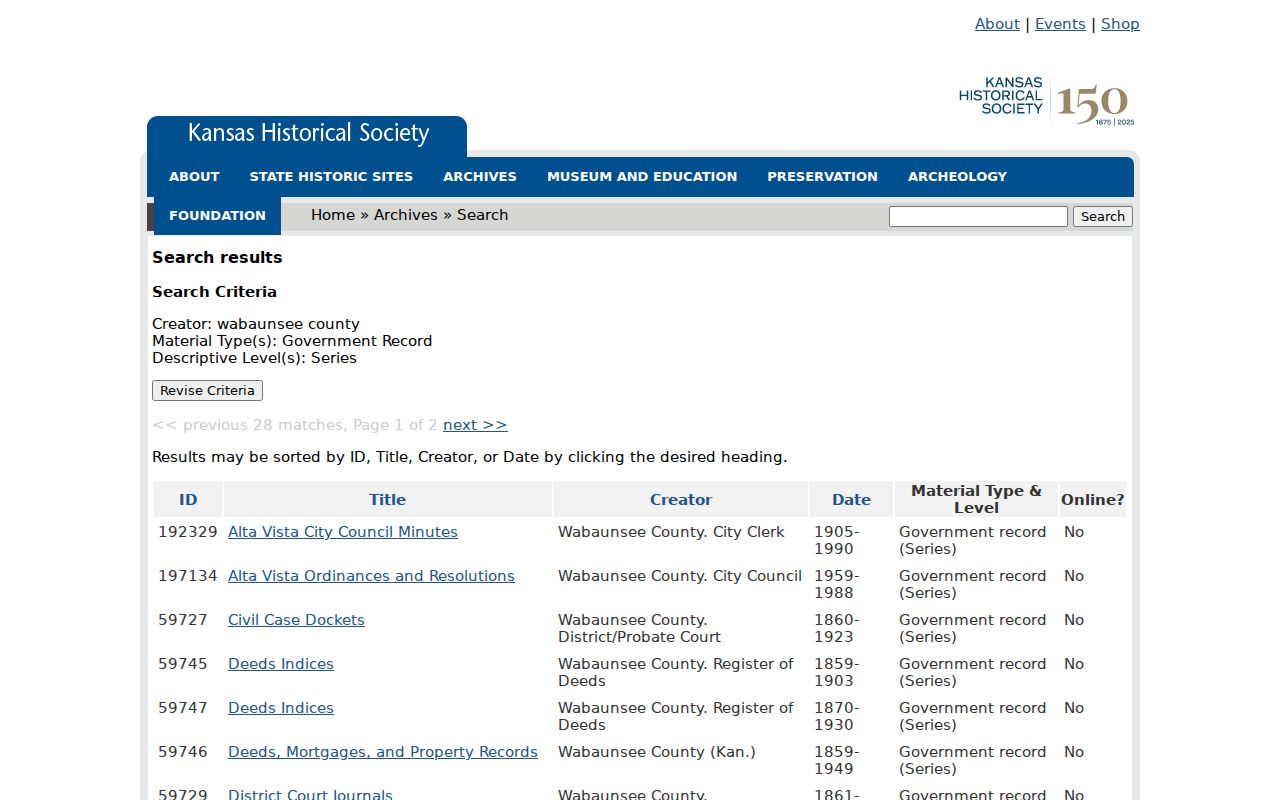
The catalog image supports the dated archival coverage used to extend the former-owner chain.
| Source | Years It Covers | Where Held | What It Shows |
|---|---|---|---|
| Courthouse deed index | Current local run; web cutoff not published | Register of Deeds | Grantor, grantee, and recording reference |
| KSHS deed indexes | 1859-1903 and 1870-1930 | State archives and microfilm | Earlier name-to-deed links |
| Deeds and mortgages | 1859-1949 confirmed run | KSHS collection | Historic instruments |
| 1902 atlas | Dated snapshot | Kansas Memory | Township owners and town plats |
Build the modern chain at the courthouse first. Only after the last useful book, party, and description is in hand should you move to microfilm.
No Online Wabaunsee Cutoff Exists
The county offers no verified online grantor-grantee index or imaging cutoff. So never assume Wabaunsee County deed records begin online in a given year. Alphabetical courthouse books remain the reliable fallback; bring names, an approximate date, and the legal description.
Walk the Wabaunsee Chain Backward
Read the newest deed first. Its grantor is usually the prior owner of record. That same party should then appear as grantee on an earlier deed acquiring the same parcel.
- Find the current grantee's acquisition deed.
- Copy its grantor and exact description.
- Find that grantor as an earlier grantee.
- Repeat through books and microfilm.
- Grantor and grantee
- Transferor and recipient.
- Chain of title
- The linked sequence of conveyances.
- Reverse index
- An index arranged to find instruments from the receiving party.
Probate Breaks a Simple Chain
Inherited land rarely moves through a plain deed. A tract can pass via an executor, administrator, trustee, survivorship term, or court order. Wabaunsee County probate journals survive on five microfilm rolls. They cover 1859 to 1918. A surname index comes with them. Use probate to establish who had authority. Then return to the deed records for the instrument affecting the parcel.
The 1902 Wabaunsee Owner Snapshot
The 1902 Standard Atlas places names on land at a single moment between deeds. It pairs township landowners with town plats and a patrons directory. An atlas label is not proof of title, though. Match it against the legal description, the courthouse deed, and the modern ORKA parcel. Trust it only after that check.
Plat Names Preserve Past Owners
Subdivision names outlast street changes in Wabaunsee County. Local notices preserve plats like Zwanzigers 1st, Stones, Prairie View, Gallaway, East Eskridge, Ensigns, and Edens as handy index terms. When a plat reshapes the description, follow the lot and block into the new addition rather than forcing the older tract wording.
Wabaunsee Archive Access Channels
Wabaunsee County offers several ways into its older records. Start at the recorder counter when the chain is modern. Go there too when the latest reference is known. A written request works when staff can pull a defined book, page, name, or date. The KORA process serves one stretch of a former-owner search. The KSHS research room covers another. A county microfilm loan handles a different stretch entirely. Move into KSHS holdings once the local index points into the historical run.
Old tax rolls and the atlas can supply a time clue. Neither one replaces an actual conveyance. Mortgages and releases explain financing without changing the owner of record. Probate clarifies a transfer by death. A quiet-title, partition, or foreclosure case can reshape the chain through a court order. Record each source and its date so a clue never gets mistaken for a deed.
Build a Wabaunsee Owner Timeline
A useful former-owner timeline has one row per possible transfer and separates proof from clues. For each deed, record the execution date, recording date, grantor, grantee, deed type, legal description, and book/page or instrument reference. Mark the source of the image or copy. If a link comes only from an atlas, tax roll, newspaper, or notice, label it as a clue until a recorded instrument or court order confirms the transition.
Start with the present legal description because it is the strongest way to keep the same land in view. Street names and mailing cities change. A parcel can be replatted or split. When a deed refers to a prior instrument or plat, retrieve that source before stepping back again. If only part of the former tract became the current parcel, document that change rather than carrying every old owner forward to the whole modern shape.
Search party variants deliberately. Try initials, full names, maiden or prior surnames, trustees, executors, administrators, companies, and estate wording. A reverse index is the grantee-side route used to find how a prior owner acquired the property. The direct or grantor side helps show how that owner later conveyed it. Both sides are needed to avoid skipping an instrument.
When the courthouse books reach the archival period, use the confirmed KSHS coverage precisely. Deed indexes run 1859-1903 and 1870-1930 in cataloged sets, while deed, mortgage, and property materials extend from 1859 through 1949. Overlapping dates reflect separate record series. They do not establish a universal online start date. Ask KSHS staff or use the research room and microfilm loan procedure for the relevant volume.
The 1902 Standard Atlas is valuable between recorded events. It shows township landowners, town plats, a directory, and patrons. Compare its owner label with the legal geography, then locate deeds before and after 1902. The atlas may reveal a likely family or tract connection, but its printed name is a dated map label, not a conveyance.
If the chain stops at death, foreclosure, partition, or quiet title, use the related court file. Historic probate journals and modern court access can identify the executor, order, or parties. Then search for the deed, decree, sheriff's instrument, or other recording that carried the court event into the land record. This disciplined return from context to conveyance keeps the former-owner list tied to evidence.
Depth of Wabaunsee Ownership Records
The confirmed KSHS run starts in 1859. That is the year Wabaunsee County was organized. Earlier federal land origins may call for patents, tract books, and surveys. No courthouse fire or land-record loss is documented, so treat the record as continuous. Reach historic volumes through the KSHS research room and microfilm route. The county deed books remain the bridge into the current chain of title.
Lawful use. Trace former owners for title, estate, and property history. Never use the results to track, threaten, or harass a living person.