
Compare Wabaunsee Property Values
The Appraiser estimates fair market value each January 1. Kansas classification rules then set the assessed value. Any past sale price sits in a separate transaction record, and the county's Role of the Appraiser page walks through that whole valuation framework.
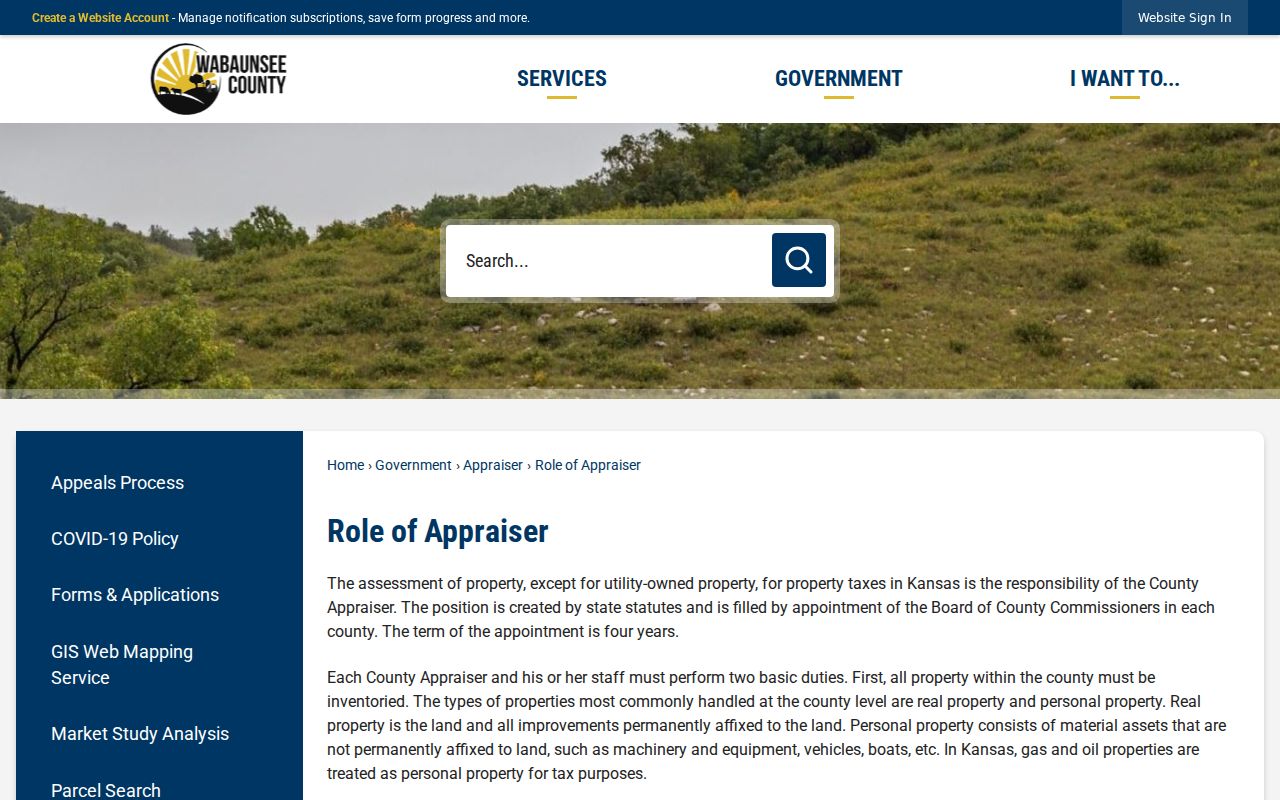
The capture supports the distinction between the appraisal value and the classified assessed amount.
| Value | What It Is | Where |
|---|---|---|
| Assessed value | Classified share used for tax | Appraiser roll |
| Market value | January 1 mass-appraisal estimate | Appraiser roll |
| Sale or consideration | Amount tied to a transfer | Deed or restricted sales data |
| Land and improvements | Components of parcel value | Parcel record, if displayed |
Wabaunsee County applies set assessment ratios by class. Residential property is assessed at 11.5 percent, while commercial and industrial parcels carry 25 percent, and agricultural land is valued by use and assessed at 30 percent. Remember that these ratios shape the tax roll, not the deed price a parcel might fetch on the open market.
2026 Wabaunsee Market Signals
The county market study points to steady movement. Residential values are trending near 2.7 percent a year, and agricultural land is up about 4.1 percent for 2026. Commercial and vacant-lot categories held stable. Treat these numbers as broad signals for Wabaunsee County property records, since no average can replace the individual parcel record or a firsthand inspection of the property.
Look Up Wabaunsee Assessed Value
Search the county parcel route by address or CAMA to pull a Wabaunsee County property record. Confirm the valuation year and the property class before reading the value, since both drive the assessed figure.
- Search the address in the county parcel system.
- Match CAMA and legal description.
- Read market and assessed value for the year.
- Check a recorded transfer separately if sale context is needed.
- Assessed value
- The classified share used for tax.
- Market value
- The mass-appraisal estimate.
- Assessment ratio
- The statutory percentage for a class.
- Reassessment
- The recurring update of value.
Free Search Excludes Sales Data
Wabaunsee County's free parcel search leaves out the registered sales-information product. Qualified fee appraisers may request that access for $200 per year. So an empty sale field in the public view proves nothing. It says nothing about whether a transfer actually happened. To trace a transfer, turn to the deed and the recorder's index. Remember that any consideration shown may still need office verification.
Agricultural Wabaunsee Use Value
Kansas values agricultural land by productive use, not by what a buyer might pay. That single rule reshapes farm and ranch assessments across the Flint Hills. Acreage, soil, and use drive the tax value in ways no residential comparison can explain, and improvements or homes on the parcel may be classified separately.
GIS Cannot Value Wabaunsee Land
ORKA is a map, not an appraiser. It displays location and reference layers for Wabaunsee County, but it cannot inspect condition, settle title, or place a value on a parcel, and its aerial imagery may predate the valuation year. Confirm the tract on the map, then return to the Appraiser's official record.
Why Wabaunsee Values Differ
Two neighboring parcels can land on very different values. Land size, class, and productive use all pull the number apart. Improvements, condition, location, and the sales evidence available do the same. A tax exemption may shift the taxable result. It does not touch the Appraiser's estimate of fair market value. A levy then changes the bill while the assessed value stands still.
Dates matter as much as labels. The Appraiser values each parcel for January 1. A deed records a past transfer. A private appraisal speaks only for its own effective date. Compare figures only after pinning down the parcel, the value type, and the year. If a field still seems wrong, gather photos, measurements, and condition facts. Pull in relevant sales before contacting the Appraiser.
Interpret a Wabaunsee Value Record
Begin by identifying the property class. Kansas does not apply one assessment ratio to every kind of property. Residential real property uses 11.5 percent. Commercial and industrial property uses 25 percent. Agricultural land uses productive use value and a 30 percent assessment rate. A farm home or improvement may be classified differently from the land beneath it. The class must be known before an assessed value can be compared with market value.
Next, confirm the valuation year. Wabaunsee County values property as of January 1. A portal update notice can be months later and only reports when the database changed. A sale after January 1 may not describe the evidence available for that appraisal date. Likewise, an older deed price can reflect different condition, acreage, improvements, financing, or market conditions.
Public sales access has a local limitation. The free parcel search excludes the county's registered sales-information product, while qualified fee appraisers may request a $200 annual account. A public user should not fill the gap with a guessed sale price. Search the recorded deed and ask the recorder whether consideration or a related filing is available. Note that a nominal or family transfer may not represent open-market value.
The 2026 Market Study is context rather than a parcel calculator. Its approximate 2.7 percent annual residential trend and 4.1 percent agricultural rise describe broader evidence; commercial and vacant-lot categories were reported as stable. Location within Wabaunsee, property type, land use, and actual parcel facts can cause a result far from a simple county percentage.
Assessed value should also be kept separate from taxable amount and tax bill. Exempt status can reduce what is taxed. The homestead program is a refund route with separate eligibility. Taxing districts set levies that act on assessed value. A higher bill can result from levy changes even when the property value is unchanged, and a value appeal does not alter the levy.
For purchase or lending decisions, a licensed appraisal answers a market question using a stated date and scope. For tax review, the Appraiser's record and appeal evidence are the relevant materials. For title or sale history, use deeds. For parcel location, use ORKA. Each record is useful when its number is kept in the job it was created to perform.
Limit Wabaunsee Value Conclusions
Wabaunsee County assessors lean on mass-appraisal models, which spread value estimates across whole neighborhoods rather than weighing one house alone. That is why an assessed value can sit apart from a sale price, an insurance figure, or a private appraisal, since each of those numbers answers a different question about the same parcel.
Value is not price. A Wabaunsee County assessed value does not state what a parcel will sell for and is not a private appraisal.